
Cities@Heart goes on ESC TV Connect

From Safe Hearts to Healthy Cities: Cities@Heart Sets Out Its Approach at ESC Congress.

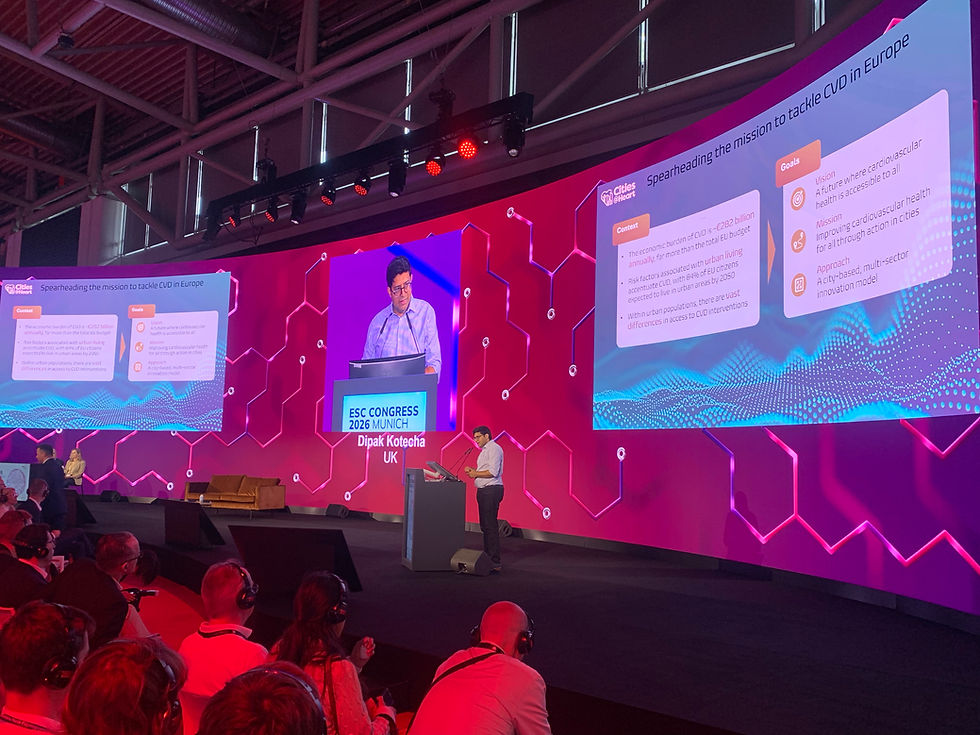
Speaking on ESC TV Connect at this year's ESC Congress, Cities@Heart Project Director Dipak Kotecha, Industry Lead Franck Perraudin (Novartis), and Donna Fitzsimons, Professor of Nursing at Queen's University Belfast, set out how the project intends to turn the European Union's Safe Hearts Plan into practical change for Europe's cities.
Adopted by the European Commission in December 2025, the EU Cardiovascular Health Plan, known as Safe Hearts, commits every Member State to developing a national cardiovascular health plan by 2027, built on three pillars: prevention, early detection and screening, and treatment and care. For Cities@Heart, an IHI-funded public-private partnership launched in January 2026, the Plan is less a backdrop than a shared point of departure.
"The Safe Hearts Plan certainly gives us that ability to focus down," said Fitzsimons, describing the burden cardiovascular disease places on health systems worldwide. "But we have a lot of responsibility to deliver that effectively across multiple different systems and healthcare regions in Europe, to begin with, and obviously the world in general."
Much of the discussion centred on why cities, rather than countries or regions, are the right unit for that work. Fitzsimons pointed to projections that 85% of the population will live in urban areas by 2030, and to stark disparities within cities themselves:

"You can see a citizen at one end of a street having to tolerate a cardiovascular risk that is sometimes to the magnitude of four to ten times that of someone who lives in a different part of their city."
Kotecha put similar figures in clinical terms. "As cardiologists, maybe we can give people an extra few years if we treat their coronary disease," he said, "but these are twenty-five-year differences in healthy life expectancy. We need something different to approach that."

Perraudin situated Cities@Heart's role alongside the Safe Hearts Plan directly.
"The objective of Cities@Heart is to impact cardiovascular mortality, so it's very much aligned with the Safe Hearts Plan,"
he said, describing the five-year, roughly 27-partner project spanning industry, academia, and government. "The beauty of the Safe Hearts Plan is that it has positioned cardiovascular disease as a major political agenda."
Cities@Heart's own contribution, the panel agreed, is to test what implementation actually looks like at city level. Working with seven cities linked to the World Health Organization's European Healthy Cities Network — Belfast, Birmingham, Cork, Izmir, Łódź, Udine, and Utrecht — the project will pilot approaches to awareness, prevention, detection, and management, focused on obesity, hypertension, dyslipidaemia, and diabetes, with results intended to inform scale-up across the wider network.
"Implementation is where the rubber hits the road," Fitzsimons said, noting that many existing clinical guidelines fail to reach the patients who need them most in practice.
Kotecha closed the session by inviting viewers to follow the project's progress at www.citiesatheart.eu and on LinkedIn, describing Cities@Heart as "just starting" a five-year journey shaped, in part, by the ambitions the Safe Hearts Plan has now set for the whole of Europe.
Full Video
The full video is available here or on our YouTube channel:
Follow us
Subscribe to our YouTube channel to stay up to date with the latest videos.

Comments