
Cities@Heart at Hospitals on FHIR User Days

Cities@Heart was represented at the HL7-organised event, Hospitals on FHIR User Days in Pisa, Italy, on October 10, 2026.

Improving cardiovascular health requires connections between the care people receive and the conditions in which they live. For Cities@Heart, this means bringing together hospitals, public health, municipal services and communities—and enabling their information systems to work together.
This challenge was explored during the Hospitals on FHIR User Days in Pisa, Italy, on 20 October 2026. A session chaired by Eva Sabajova of HL7 Europe brought the Cities@Heart perspective into a wider One Health discussion, examining how HL7 FHIR and shared terminologies can connect clinical, environmental and urban information to support better decisions for people and communities.
Starting with a person living with cardiovascular disease
The session began with the introduction of Maria, a fictional 72-year-old woman living in Pisa with cardiovascular disease, heart failure and a pacemaker, alongside anxiety and depression. Shortly after her discharge from hospital, a heatwave is forecast.
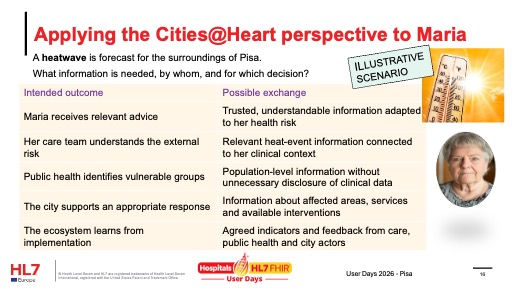
Maria’s situation illustrates why cardiovascular care extends beyond the hospital. Her clinical history is held by healthcare providers, environmental systems describe the expected heatwave, and municipal services hold information about neighbourhood conditions and available support. Maria and her family understand her circumstances at home, while public health teams assess vulnerability across the wider population.
For Cities@Heart, this scenario raises practical questions: What information would help those supporting Maria coordinate her care? How could relevant information about her surroundings inform that support? And how can cities use information from different sectors to strengthen cardiovascular prevention and address inequalities?
Answering these questions requires agreement on what information is needed, who needs it and how its meaning will be preserved when shared.
Making information useful across the city
HL7 Europe’s contribution to Cities@Heart focuses on the interoperability needed to support these connections, including through FHIR implementation guides and the planned Cities@Heart Accelerator.
FHIR provides a standard for structuring and exchanging information. Shared terminologies help ensure that the people and systems receiving it interpret it consistently. Together, these can support the development of solutions that connect cardiovascular care with public health and the wider city environment.
Stratos Kokolakis of HL7 Europe highlighted the importance of these semantic connections. Clinical, environmental and municipal systems may use different definitions, geographic boundaries and observation periods. Bringing their data together requires careful attention to context.
For example, a temperature recorded at an environmental monitoring station does not automatically describe the conditions experienced by an individual patient. Its location, observation time, measurement method and units must remain clear. Such distinctions matter when exploring how environmental information could inform cardiovascular care or city-level prevention.
FHIR implementation guides can document these choices, helping partners develop and test solutions with a shared understanding of the information exchanged.
Learning across projects and moving towards implementation
The session also featured Sónia Serra of the University of Coimbra and OneAquaHealth, a European project investigating connections between urban freshwater ecosystems and human health and wellbeing. Her contribution brought an environmental perspective to the discussion, highlighting place, time and meaning as essential considerations when connecting information across sectors.
The planned Cities@Heart Accelerator will bring partners together through hackathons and connectathons to develop and test interoperable solutions for participating city ecosystems. These activities will help translate use cases into practical requirements, identify existing standards that can be reused and clarify where further implementation guidance is needed.
The Pisa session provided a starting point for that work: keeping people such as Maria at the centre while exploring how connected information can support cardiovascular prevention, coordinated care and healthier urban communities.
Further opportunities to continue this exchange include the HL7 Europe Working Group Meeting in Málaga on 16–20 November 2026.


Comments